
(This article written by J.D. Heyes was published on NaturalNews.com on 6/1/12.)
Learn more: http://www.naturalnews.com/036063_GMOs_foods_infographics.html#ixzz240HwuT48 )
 “We here at NaturalNews.com pride ourselves in providing our readers with the most valuable, up-to-date news and information on a wide range of health-related issues, but we especially like to discuss nutrition because so much of our health depends on what we put in our bodies – and what we don’t put in them.
See the NaturalNews infographic at:
http://www.naturalnews.com/Infographic-Top-10-GMO-Foods-to-Avoid-Eating.html
Be aware and beware
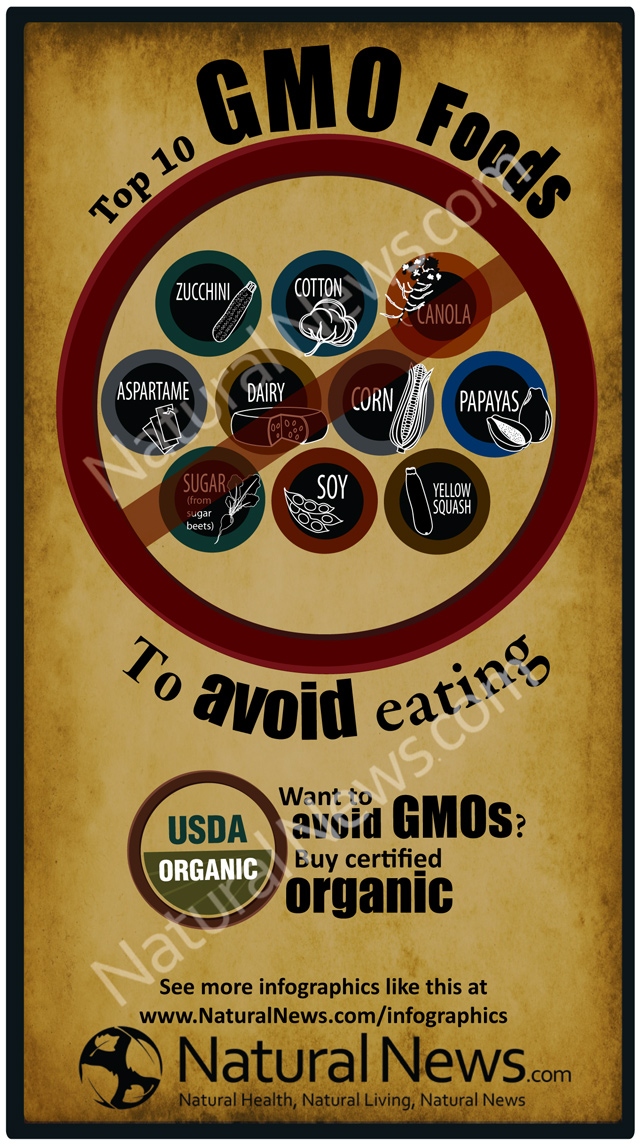
With that latter thought in mind, we’ve developed an infographic to highlight the top 10 GMO (genetically modified organism) foods to avoid, in no particular order:
1. Zucchini: It goes without saying that many biotech companies say genetically modified foods are safe for you, but as GMO science expands, reseachers are finding more evidence that such foods can harm your health. One of those is zucchini. While not as potentially harmful as other GM foods, zucchini is nonetheless “engineered” to resist some strains of virus.
2. Cotton: Considered a food item because its oil can be consumed, cotton – in particular, genetically modified Bt cotton, common to India and China – has damaging consequences. According to recent Chinese research, while Bt cotton is capable of killing bollworms without the use of insecticides, its decreased use has increased the presence of other crop-harming pests. Also, Bt cotton production has been linked to drastic depletion of soil nutrients and lower crop yields, as well as much higher water requirements.
3. Canola: This is probably one of the most misunderstood, misguided “healthy” food choices out there right now, but there is little about canola – and similar oils – that is good for you. Extracted from rapeseed, canola oil and others must be chemically removed from the seeds, then deodorized and altered, in order to be utilized in foods. They are among the most chemically altered foods in our diets.
4. Aspartame: An artificial sweetener found in a number of products, aspartame – discovered by accident in 1965 by a chemist testing an anti-ulcer drug – accounts for as many as 75 percent of adverse reactions to food additives reported to the Food and Drug Administration (FDA), according to some reports. Some seizures and even some deaths have been blamed on aspartame.
5. Dairy: A disturbingly high number – as many as one-fifth – of dairy cows in the U.S. today are given growth hormones to increase milk production, a figure that has been rising since the FDA approved a genetically engineered recombinant bovine growth hormone known as rbGH or rbST for use in dairy cows in 1993. While said to boost production by 5-15 percent, scientists have expressed concern that the increased levels of IGF-1 (insulin growth factors-1) from hormone-treated cows may boost the risks of colon and breast cancer. Since 2008, Hiland Dairy has stopped using milk from dairy farmers who inject their cows with growth hormone.
6. Corn: Modified now to create its own insecticide, as many as half of all U.S. farms growing corn for Monsanto are using genetically modified corn, with tons of it now being introduced for human consumption, according to the FDA. Doctors at Sherbrooke University Hospital in Quebec recently found Bt toxin from modified corn in the blood of pregnant women and their babies, as well as in non-pregnant women.
7. Papayas: Genetically modified papayas have been grown in Hawaii commercially since 1999, designed to combat the Papaya Ringspot Virus. Approved for sale and consumption in the U.S. and Canada, GM papayas cannot be imported or sold in the European Union.
8. Sugar: Sugar from genetically modified sugar beets hit the market in the U.S. in 2009. They were modified by the Monsanto Corporation to be resistant to the company’s Roundup herbicide. In 2010 a group of Oregon farmers sued to stop planting that year of Monsanto’s genetically altered sugar beets over fears the crops could cross-contaminate other nearby fields.
9. Soy: Like other foods, soy, too, has been genetically modified to resist herbicides. Soy is included in soy flour, tofu, soy beverages, soybean oil and scores of other products, especially baked goods and pastries. According to one report, “[a]fter feeding hamsters for two years over three generations, those on the GM diet, and especially the group on the maximum GM soy diet, showed devastating results. By the third generation, most GM soy-fed hamsters lost the ability to have babies. They also suffered slower growth, and a high mortality rate among the pups.”
10. Yellow squash Like zucchini, yellow squash is also a fast-rising GMO crop in the U.S., and as such, should cause you concern. If you like squash – and scores of Americans do – check out a farmer’s market that doesn’t sell GMO squash or grow your own using non-modified seed.”
Sources for this article include:
http://www.naturalnews.com/Infographic-Top-10-GMO-Foods-to-Avoid-Eating.html
http://www.naturalnews.com/035734_GMOs_foods_dangers.html
http://www.deccanherald.com
http://www.hilanddairy.com/green/no-artificial-growth-hormones
http://www.huffingtonpost.com
Learn more: http://www.naturalnews.com/036063_GMOs_foods_infographics.html#ixzz240HZgvcK


 Completely Nourished