
 Raise your hand if you like pancakes and syrup! Now, leave your hand up if you can name the ingredients in your syrup without grabbing the bottle from your cupboard….
What?! Ingredients in pancake syrup?! Isn’t syrup just syrup…like from a tree? Well, it should be, but most syrups available at typical grocers are far from it!!! In fact, if you take a look, chances are that your “syrup” says something like “pancake syrup” on the front of the bottle, not “maple syrup”…and that’s because there’s no real maple syrup in there!
Why? Because it’s cheaper for the manufacturer (and the consumer) to make fake syrups from corn syrup, fake coloring and additives, than to harvest the real thing! (Did you know that it takes about 43 gallons of sap to make 1 gallon of maple syrup!)
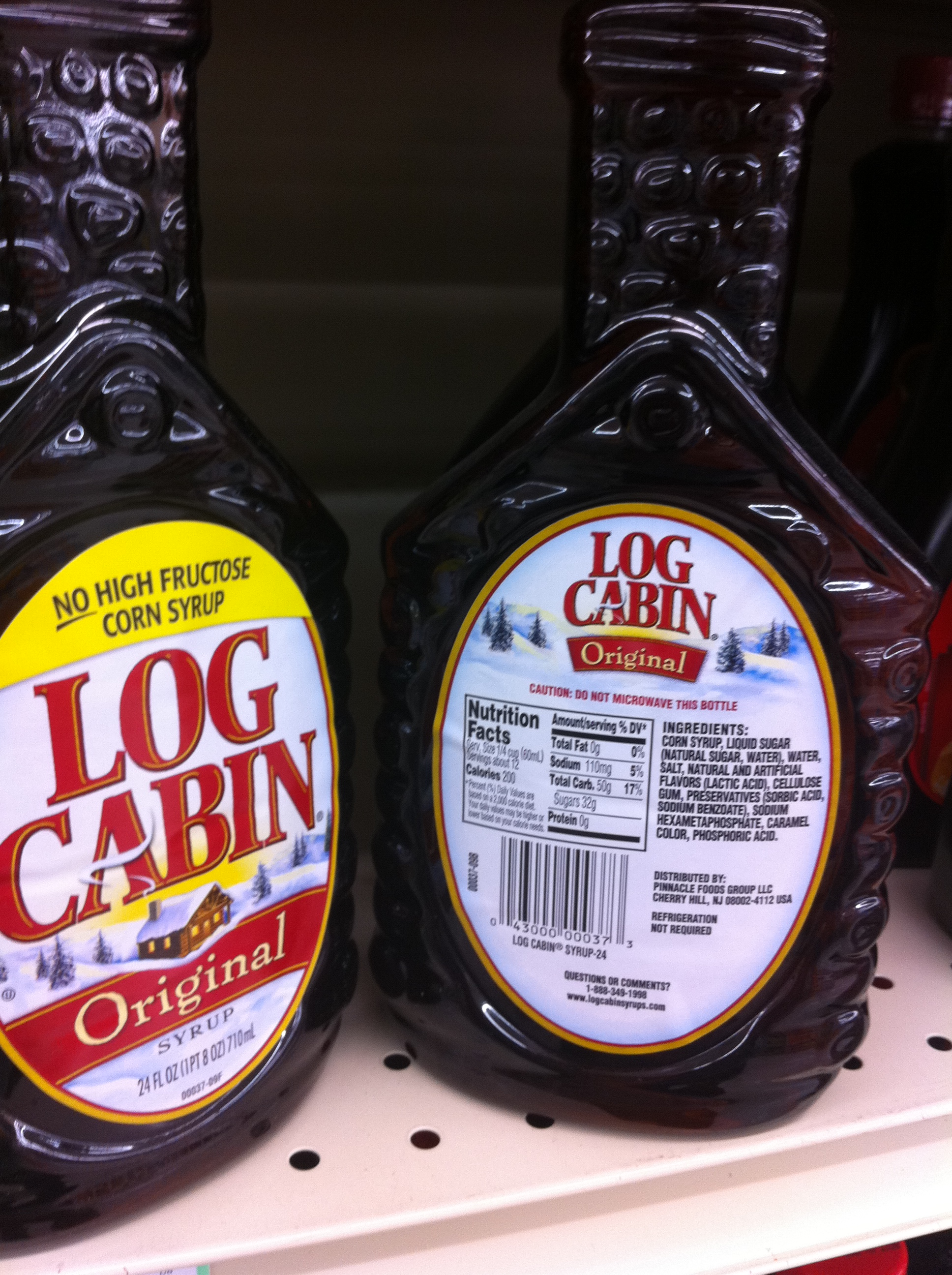
Alright, so here are some examples of various syrup choices you might find at your typical grocer (click images to enlarge and read the ingredients for yourself)…

First, the example from above. See how it says “syrup” on the front with no mention of maple? That’s your first clue. But ALWAYS check the back for an ingredients list. Ah, there’s the “Hexametaphosphate” (and lots of other goodies like carmel color, etc.) Yum!?
 Next we have good ol’ Mrs. Butterworth – a staple in my family’s pantry when I was growing up. (Although, I never ate it – I always hated even the smell of syrup so I stuck with just butter on my pancakes. Hmm…maybe my taste buds were just smart!). No wonder she talks in those commercials…it distracts us from asking about her component parts which happen to include High Fructose Corn Syrup, Flavorings, Colorings and our good buddy Hexametaphosphate!
 Getting hungry, yet?! Alright, so maybe you’re convinced about the dangers of High Fructose Corn Syrup, so you select this brand which brags about not containing it! But wait….better check the ingredients! Just because a company brags about one thing on the front doesn’t mean there aren’t other things to worry about on the back. And this one doesn’t look much better than the others, really.
 Speaking of ignoring claims on the front of packages….this one is a great example. It screams at you from the shelf that it’s “All Natural,” so that’s a good thing, right?! Yes, natural = good (but only when something is truly natural). The word “natural” is not regulated by the FDA, so any manufacturer can use the claim to mean whatever they like. A truly “all natural” syrup would be pure maple syrup from a tree in nature. But a quick read of the ingredients list on this product reveals that’s only 4% of what’s in here!
 Alright, so pure maple syurp is what we’re looking for, but before we get there…I have to show you this last one that truly takes the cake. I was laughing out loud in the grocery aisle when I saw this one! This brand actually brags on the front label that it contains a whopping 2% pure maple syrup!!! OH….MY…GOSH!!! I am absolutely stunned at this marketing tactic! If anything, I would think it just draws to people’s attention that 98% of the product is….well, something else. And, from my experience, most folks already incorrectly assume that any syrup is pure maple syrup, so this company may be doing itself a disservice (don’t get me wrong….that’s fine with me!).
 Whew! Anyone else exhausted?! Ok, so here’s an example of what you do want, and it’s likely sitting on the top shelf of the syrup section at your regular grocer. It says “pure maple syrup” on the front, and when you double-check the ingredients on the back (as I always require), it reveals the same. Just one ingredient, as it should be. Is it more expensive? Yes, of course! Does it taste better? Absolutely! Better for you? You guessed it!!
Here are a couple money-saving tips to help you offset the cost of your new real maple syrup expenditures:
1. Only use what you need! Don’t let the kids pour 2 cups of syrup all over their plates and then dump 1 1/2 cups down the sink drain 😉
2. Don’t eat syrup foods very often. Most breakfasts that require syrup (e.g., pancakes) really aren’t good for you anyway, so start serving them more as a special treat rather than standard breakfast fare. 🙂
3. Buy in bulk. This picture is a pretty small container, but larger containers are available at lower (per ounce) prices.
For more great additive-free shopping and cooking tips, be sure to SUBSCRIBE to my blog!
And check out my book (and e-book), “Eating Additive-Free” – Natural Cookbook & Grocery Shopping Guide, too!
Happy shopping!!!








 Completely Nourished