
Chewy Grain-Free Cookies

CHECK OUT OUR RECIPES PAGE FOR MORE GREAT RECIPES!!!

These cookies are gluten-free, dairy-free…and egg-free! And they are chewy and delicious!

(Psst….If you enjoy this recipe,  be sure to get yourself a copy of our additive-free cookbook & grocery shopping guide, “Eating Additive-Free“! It’s stuffed with 150+ more tasty recipes!! Your satisfaction is guaranteed…or your money back!)

Makes about 12 cookies
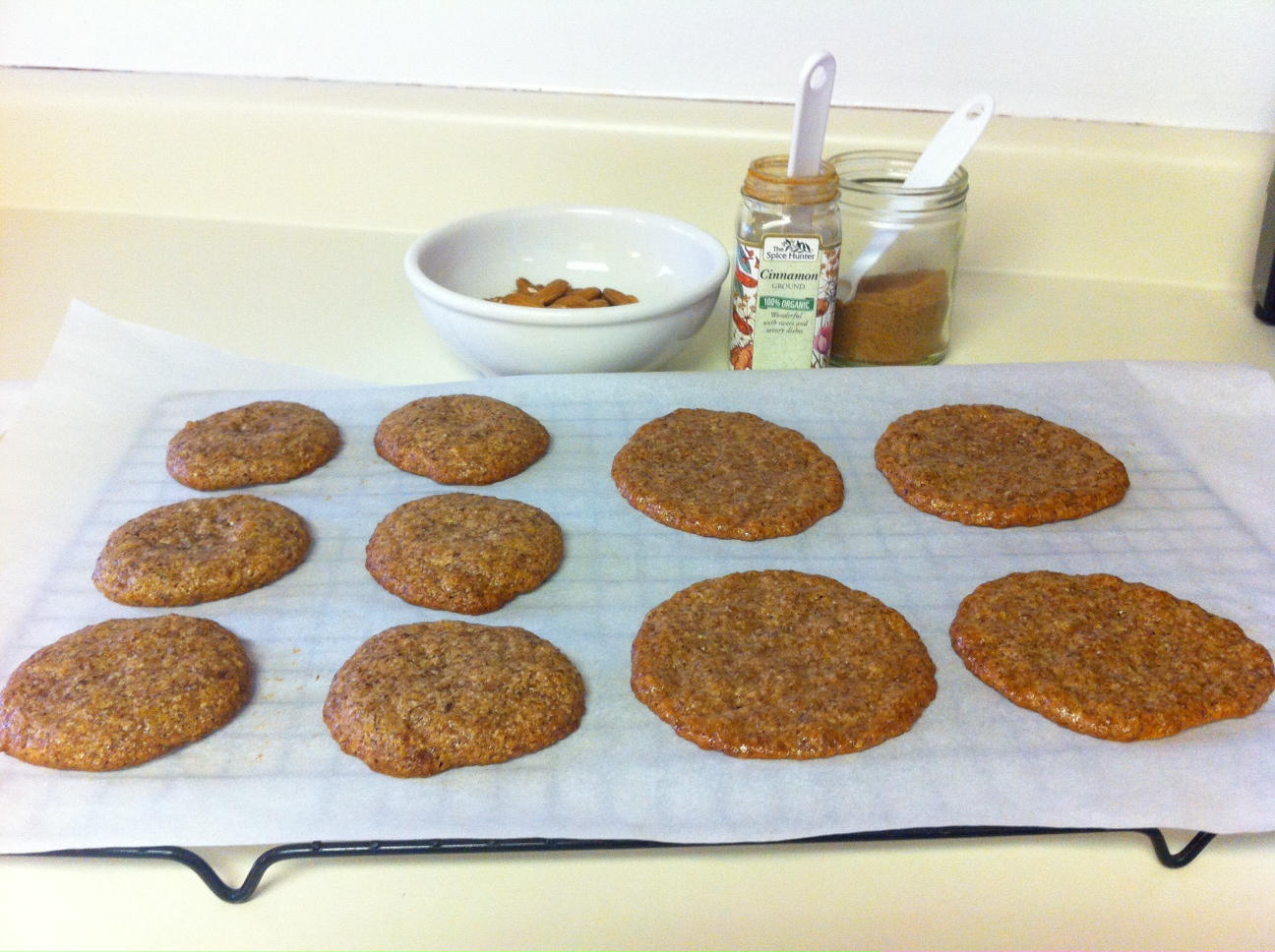
Chewy Grain-Free Cookies (egg-free)2 (click photo to enlarge)

INGREDIENTS:
1/4 cup coconut oil
1/3 cup raw honey
1/2 TBSP pure vanilla extract
1 – 1 1/4 cups almond meal* (See note below!)
1/4 tsp sea salt
1 tsp ground cinnamon
1/8 tsp ground nutmeg

*Check out our Grocery Shopping Guide for our tips on selecting the most additive-free versions of every ingredient used in our recipes.

DIRECTIONS:

1. Preheat oven to 350F, and line 2 large cookie sheets with parchment paper.

2.Melt oil and honey together in a small sauce pan.

3. Meanwhile, combine all dry ingredients in a medium bowl.

4. Remove oil and honey from the heat and stir in vanilla extract.

5. Stir wet ingredients into dry ingredients. Dough will be more the consistency of brownie or cake batter than cookie dough, but that’s just fine. 🙂

6. Drop dough by rounded tablespoon onto parchment paper. I literally use a TBSP measuring spoon for this step. Especially if making the thin variety, don’t place more than 6 cookies per sheet because they spread out a LOT!

7. Bake one sheet at a time on middle rack for about 8 minutes, until edges just begin to brown. Watch carefully in the final couple minutes, as ovens vary and these turn quickly from “done” to “burnt”!

8. Slide cookies (w/ parchment) onto a cooling rack. Enjoy warm or allow to cool completely for about 20 minutes, and enjoy!

*Almond meal note:
For thicker cookies (shown in the photo above on the left), use 1 1/4 cups. For thinner cookies (shown in the photo above on the right), use just 1 cup almond meal. Both varieties are equally chewy and delicious, but Chad and I prefer the thinner ones!! Also, I’ve only tried these with Trader Joe’s brand almond meal, not almond flour, so I’m not sure how these would work otherwise. I did also try with my own homemade almond meal, but I needed to use 1 1/4 cup of that to get the thinner version (instead of the just 1 cup needed with the store-bought variety), and I didn’t try to make the thicker variety with my own almond meal. I assume the difference is that the store-bought variety is drier??

CHECK OUT OUR RECIPES PAGE FOR MORE GREAT RECIPES!!!

(If you enjoy this recipe,  be sure to get yourself a copy of our additive-free cookbook & grocery shopping guide, “Eating Additive-Free“! It’s stuffed with 150+ more tasty recipes!! Your satisfaction is guaranteed…or your money back!)


FREE opportunity to view full-length documentary (until 3/31/13) – “HUNGRY FOR CHANGE”

hungry for changeIf you’ve been wanting to view the documentary “HUNGRY FOR CHANGE,” you can do so online for FREE now through March 31, 2013!!!
Below is a preview, but register here to view the film in its entiretyhttp://www.hungryforchange.tv/
Here’s the film description from their website…
“HUNGRY FOR CHANGE exposes shocking secrets the diet, weight loss and food industry don’t want you to know about. In this free online screening event you’ll discover:
•The real truth behind “DIET”, “SUGAR-FREE” and “FAT-FREE” products
•How to overcome food addictions and cravings
•How to navigate your supermarket – what to buy and what to avoid
•Why fad diets don’t work
•What food additives to avoid and how to read labels
•The most effective detox and cleansing strategies, and
•How to eat for clear eyes, glowing skin and healthy hair
Featuring interviews with best selling health authors and leading medical experts plus real life transformational stories from those who know what it’s like to be sick and overweight. If they can do it so can you!”
Below is a preview, but register here to view the film in its entiretyhttp://www.hungryforchange.tv/
Enjoy!

5 Tips For Growing Nutrient-Rich Food

5 Tips For Growing Nutrient-Rich Food

Phil with his beautiful, nutrient-rich garden!

We hope you all enjoy today’s guest post from Certified Organic Gardener Phil Nauta of SmilingGardener.com. Be sure and leave a comment for him below if you have questions or would like more info…

5 Tips For Growing Nutrient-Rich Food

I’m so glad that Christy and Chad talk about gardening once in awhile here, because to me, it’s one of the best ways to ensure you’re getting adequate nutrition.

That’s because most everything in your soil goes into the food you grow and then into you, and whatever’s lacking in the nutrient profile of your soil won’t make it into that food.

Eliminating chemical fertilizers and pesticides is a good start, but it’s only a start. That’s what not to feed our plants and soil, but what do we feed them instead?

Just like us, plants (and other beneficial soil organisms) need well-balanced sources of over 80 trace minerals, as well as the basics like plenty of air and water.

So feeding them just nitrogen, phosphorus and potassium isn’t going to result in plants that have the right levels of zinc, selenium, magnesium, and boron, let alone enzymes, vitamins, phytohormones or antioxidants needed for their health or for ours.

There are a few simple things we can do to ensure that our soil, our plants, and we ourselves are getting fully balanced nutrition from our gardens.

This is what I’ve done to dramatically increase the nutrition in my food, and I’ve helped many others do it, too:

First, we can make a great start by feeding our soil lots of organic matter on a regular basis.

The simplest way to do this is by mulching – covering the soil surface with a layer of organic matter so it’s never bare.

Besides the water- and temperature-moderating effects of mulching, it’s also the easiest, most natural way to add nutrition to the soil, without the extra work and destructive effects of repeated tilling.

This will be most effective if we use nutritious materials for mulch. Leaves are a great, nutritionally balanced mulch source that’s widely available for free.

Any deciduous tree leaves will do, but it’s usually best to avoid conifer needles since they contain compounds that inhibit the growth of other organisms.

If you live near the coast, seaweed is an amazing source of perfectly balanced nutrients and natural plant growth hormones. Collect it from the beach after a storm and put it in your compost or spread it right on top of your soil as a mulch. If that’s not easy to access, liquid kelp fertilizer is now widely available at garden stores.

In fact, the sea itself is an amazing source of perfectly balanced nutrients for soil and plants. You can apply seawater directly to the soil at as much as 1 cup per square foot, or buy very concentrated sea mineral products.

In case you’re concerned about the salt, it isn’t a problem at normal application rates, when balanced with all of the other minerals in seawater, unless you happen to have too much sodium already.

Glacial rock dust is another excellent, balanced source of mineral nutrients that will benefit your soil and plants, no matter what conditions you start with. You can find this at some garden supply stores.

Finally, compost is not only an important source of nutrients if made well, but a great way to breed the beneficial microbes we want in our gardens.

By making sure that we consciously feed our compost balanced nutrients, rather than just treating it as a scrap heap for organic waste, it can hugely add to our garden’s fertility.

These are just a few simple suggestions to get you started. The main thing is to get started!

I was amazed and relieved to discover, after years of thinking and reading about the problems with the industrial food system and how important it is to try alternatives, that I really enjoy getting my hands in contact with the earth. Feeding my soil turns out to feed my soul as well as my body.

Feel free to ask me any questions below about how to grow more nutritious food.

Do you already use some of the methods I mentioned? Or do you have any tips of your own? Let me know below.

About the Author

Phil Nauta is a SOUL Certified Organic Land Care Professional. He teaches practical organic gardening tips to home gardeners at SmilingGardener.com.